Cubans are protesting totalitarianism, not socialism

Whenever something bad happens in some totalitarian government, the right is the first to scream that the problem is “socialism.”

They conveniently ignore all the democratic countries that are primarily socialist and instead look at the few that are run by dictators. “Look how bad Venezuela is!” they scream. “Clearly, it’s because of their socialist policies and not at all because they have a terrible dictator running things.” The fact that most of Europe, Canada and Japan have socialist economies of varying degrees doesn’t convince them. It has to be socialism! It can’t be the evil dictators!

Now, admittedly, given right-wing support of oppressive governments like Russia and what Trump wanted to turn the U.S. into, you can sort of understand their obsession of finding another reason for a country’s failure than authoritarianism. But mostly it’s just a misunderstanding of the distinction between a government and its economy.

(Current protesters in Cuba, who have specifically said it’s the dictatorship they are protesting, not socialism. Not that facts matter to the right.)

Here’s a very short abbreviated version of the difference:

Economic

Capitalism.  This is where the market decides and government stays out of it.  No minimum wage, no health inspections, no laws against discrimination, no regulations on business at all.  This doesn’t work, because you end up with the powerful running everything, destroying the economy, and keeping people in poverty.

Communism.  This is where the government runs business.  The idea is that we should all live together in peace and harmony and share everything, and the President earns the same amount as the guy who sweeps the street.  This also doesn’t work, because it completely destroys initiative and any reason to try to improve yourself.

Socialism.  This is where most countries are, where the government regulates business to prevent the abuses capitalism can bring, and provides many services (libraries, hospitals, parks, fire departments, social security, unemployment, etc.) This is the tough balance to meet.  You don’t want to go too far in either direction, and most of the debate in the US is over how far to go.

Political

Democracy.  This is where the people decide, usually through representative democracy or republicanism.

Totalitarianism.  This is a dictatorship, whether individually controlled (North Korea) or committee controlled (China).  Once more, there are degrees here as well as various types (monarchy, fascism, oligarchy).  But the key thing they all have in common is that the decision-making power is not with the people.

So happens is that people confuse the economic with the political.  The Soviet Union was a communist country but was also a totalitarian country. Cuba has a socialist economy but is a dictatorship. It is possible to have a democracy that is communist if the people vote for it, and it’s also possible for a totalitarian capitalist country.

It’s even more confusing when countries lie about themselves.  Just because you call yourself “the Democratic Republic of Vietnam” doesn’t mean you are a democratic republic, any more than China is the “people’s republic.” The Soviet Union was indeed a communist country, but it was a corrupt one because you know perfectly well that not everyone shared equally in that society.

So whenever some right-wing fool tries to blame terrible conditions in a country on “socialism,” take it with a grain of salt. Could socialism be part of the problem? Sure, if poorly managed. So can capitalism. But when the real reason is a terrible dictatorship, you don’t have to ignore that to find a scapegoat you’re more comfortable with.
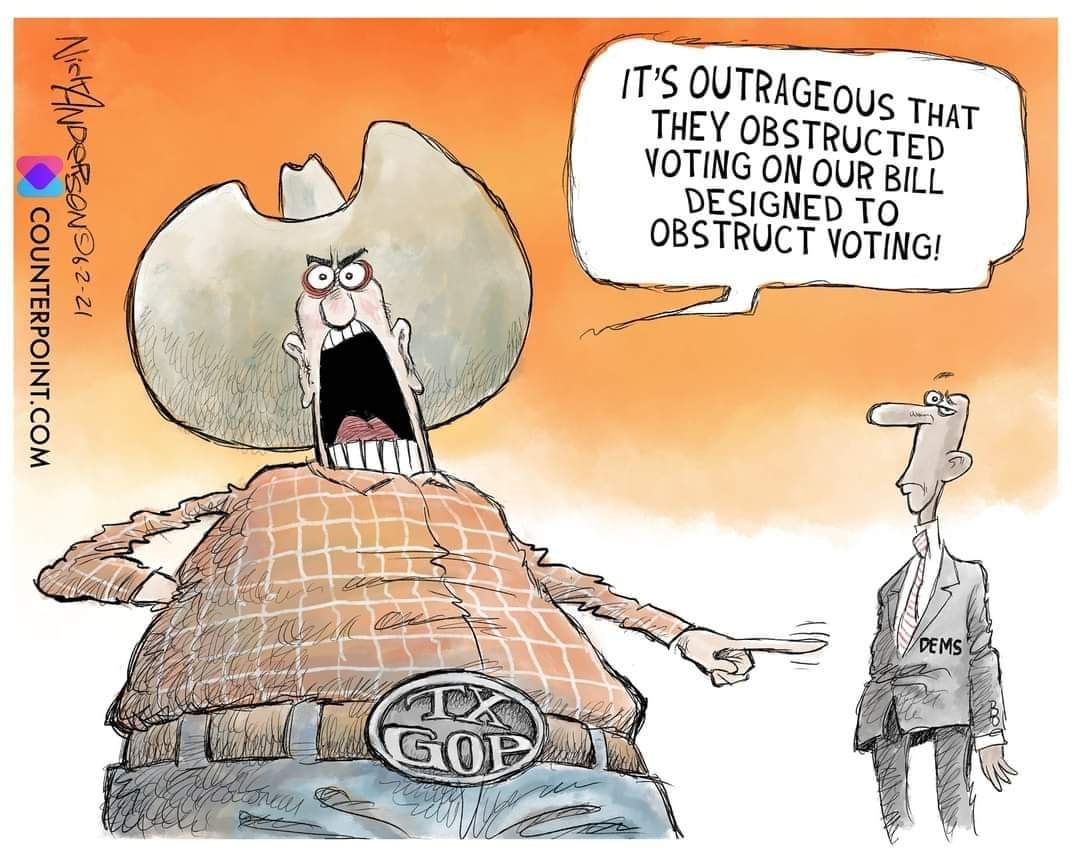
Texas logic

Nick Anderson

Texas Democrats and their Lack of Options

Republicans in Texas (like in many other states) are doing everything they can to make the most basic right in a democracy harder, because Republicans know that the only way they can win is by cheating.

The Democrats in Texas have left the state to prevent the Republicans from having a quorum to enact these laws.

Some people are saying this is unfair and that the Democrats should “do the job they were elected to do.”

Well, they are. They’re protecting the rights of voters, just like they’re supposed to do.

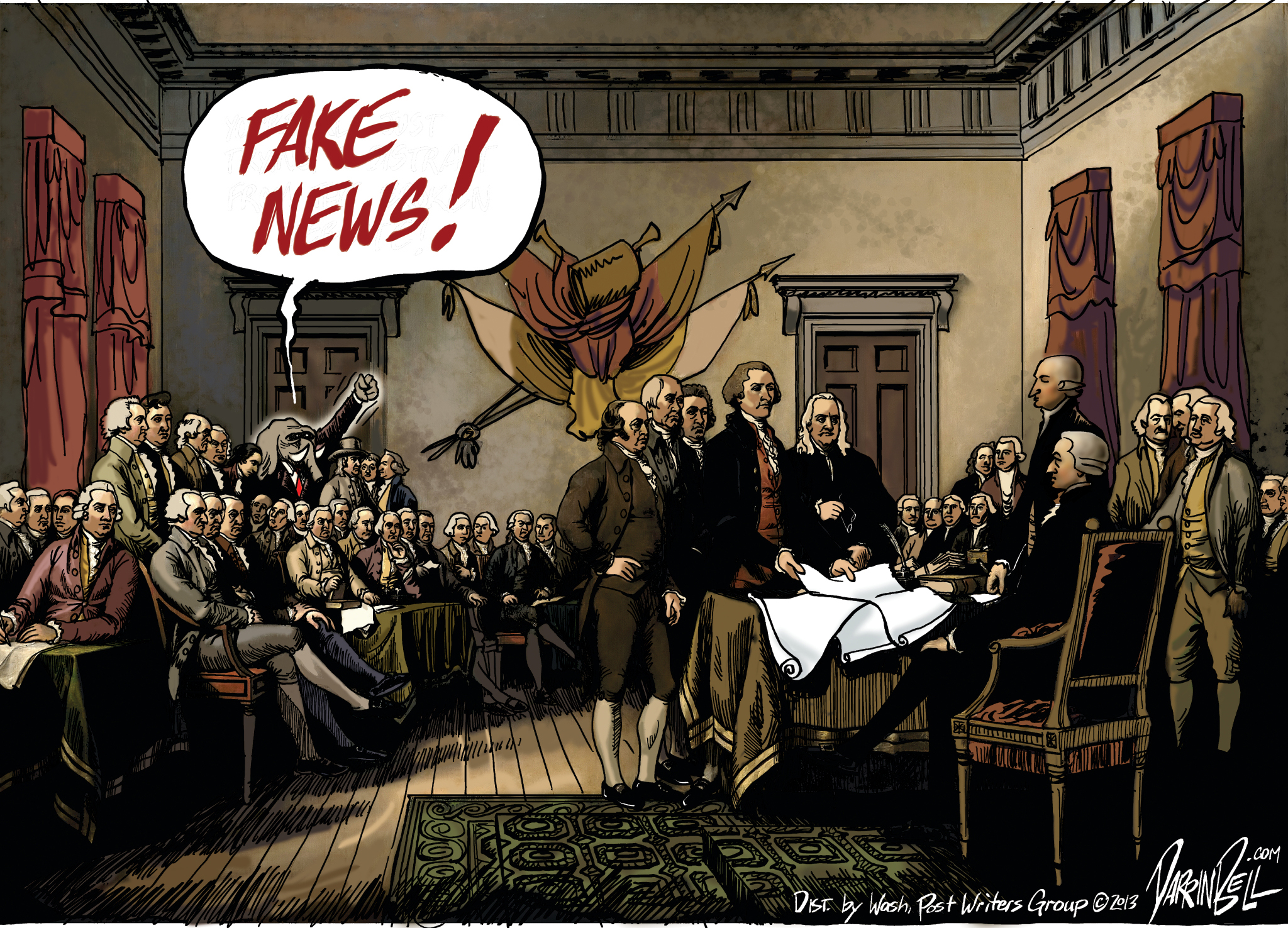
The GOP has fixed the game so that the only way they can do their job is by protesting. You know, the thing the Founding Fathers did a lot of. The thing that is protected by our very first Amendment. That thing.

“But the laws have a process that should be followed! They’re supposed to vote!” This argument has been used for generations to justify discrimination and bad laws. “Well, I’m sorry you don’t like the fact that blacks can’t vote, but the laws preventing them from voting were passed according to our rules.” Well, sure. But if the rules allow the majority to trample on the rights of the minority, what other option does the minority have?

The Texas Democrats are stuck using this as a means because the rules have been written by those in power to prevent any other means (in the same way the Filibuster is preventing the majority from accomplishing their goals in the US Senate).

Texas is, believe it or not, a purple state. Beto O’Rourke came this close to defeating Ted Cruz. Trump won it by only 1.3%. Republicans have gerrymandered the state in such a way that they control far more than 1.3% of the state house. They’ve used legal means to disenfranchise many voters, and now they’re trying it again.

Here’s a map. Notice how all the cities (which are heavily Democratic) have been divided in such a way that it is practically impossible for Democrats to win. Instead of having one big district in a city, it’s split so that the Democratic part of the city is overshadowed by the Republican rural areas adjacent to it. So. If we had a fair playing field, maybe one could argue that refusing to play is unfair. But the game is rigged, and the only way to fight it is to refuse to play.

Lack of power

Clay Bennett

The difference between the Declaration of Independence and the Constitution

I’m always surprised by Americans who don’t know the difference between these two documents, so here’s a brief summary:

The Declaration was written by Thomas Jefferson and signed in 1776, with John Hancock’s signature prominent.

This is the document that says, basically, “Hey King George! Screw you!” It starts off with “When in the Course of human events, it becomes necessary for one people to dissolve the political bands which have connected them with another, and to assume among the powers of the earth, the separate and equal station to which the Laws of Nature and of Nature’s God entitle them, a decent respect to the opinions of mankind requires that they should declare the causes which impel them to the separation.” (Or, to be more concise, “Here’s why we’re leaving, asshole.”)

The Declaration also has the famous sentence “We hold these truths to be self-evident, that all men are created equal, that they are endowed by their Creator with certain unalienable Rights, that among these are Life, Liberty and the pursuit of Happiness.”

Neither of those sentences can be found in the Constitution.

The Constitution came eleven years later, after the war was won. It was mostly written by James Madison. Alexander Hamilton played a huge role in this as well, especially thanks to the Federalist Papers he wrote (along with Madison and John Jay, who later became the first Supreme Court Chief Justice). These treatises not only helped to convince the states to pass the Constitution, but the ones from Hamilton were also amazingly poetic and even danceable, because he was not giving up his shot. Thomas Jefferson’s writings were influential but he was prohibited from attending the discussions on the Constitution, mostly because he was in France at the time.

But here’s where the confusion really sets in: Stupid people point to the attack on the Capitol and other violent acts against our government and say that rebelling against the government like that is their “right.”

Well, no. No, it isn’t.

The Declaration of Independence was aimed at a specific person, named in the document. It says that we have the right to rebel against a king, a dictator, a tyrant.

The Constitution talks about democracy. You don’t have the right to rebel against a democracy under our Constitution, because we have other means of changing things, through elections and our laws. The Constitution specifically says such action against the United States is treason and punishable, and the Founding Fathers all agreed. (Just look up “The Whiskey Rebellion” and see how the Founders dealt with this kind of treason in our early years.)

Attacking the Capitol when you don’t get your way is the most unAmerican thing you can do. These idiots who claim to be “patriots” while destroying property and killing police officers are deluded and insane.

And on this July 4th weekend, we need to remember that.

The cover of my book “How to Argue the Constitution with a Conservative,” a small portion of which is in this post. Artwork by Darrin Bell

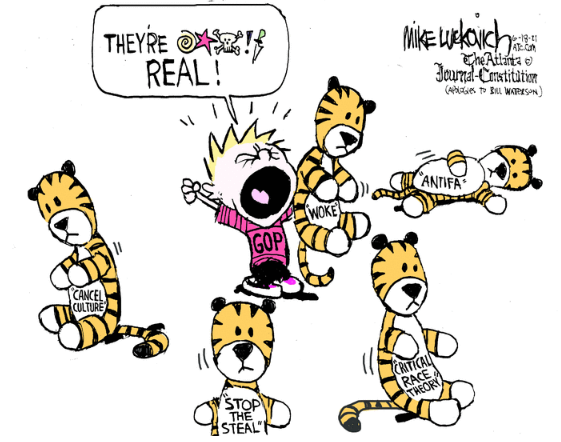
Fantasy tigers

I Miss my Dad

It’s Father’s Day again.

My Dad taught me so much. Not through lectures or lessons — but by example.

He was an artist but a realist. He worked as the art director for the local TV station but quit when the station was bought by new owners he didn’t like. He then started his own business as a sign painter in the days before computers, when if you wanted lettering on your truck for your business, someone had to actually paint it on the truck for you. He worked out of the basement of our house, so he was always home and there for me.

He taught me about respecting women, because he loved my mother and never abused her. He taught me about the importance of honesty and doing the right thing even when no one would know. He never drank or used foul language, and I grew up never drinking or cursing. He never discouraged me from my interests in music or drama or any other crazy projects I had as a kid.

He taught me to be independent and enjoy life — and I think that was a lesson all of his kids learned, as each of us ended up starting our own businesses and/or being very independent in our lives.

He had a great sense of humor, loving his Pogo books and puns. I even got him laughing at Monty Python.

One Christmas, we hung the Christmas tree upside down from the ceiling. Another time, he got a huge one, put it in the living room so everyone driving by could see it from the window, and then put the top of the tree on the roof so it looked like it had crashed through the ceiling.

And our house was always full of kids and music and art, not just from me and my two brothers and one sister, but from lots of neighborhood kids who hung out there while mom made Chef Boy-ar-dee pizzas for everyone.

I had a happy childhood, and it wasn’t until I was older that I realized it. We always saw happy families on TV sitcoms and thought that was normal, but I recall it was my friend Mark Waid in High School who opened my eyes. He pointed out that most of my friends came from broken families, and the reason everyone liked to hang out at our house was because “everybody wanted to be a Ventrella” and have a happy family.

He died soon after I had graduated from law school. He had smoked a pipe most of his life and the lung cancer got him.

But I knew he was proud of me and I was proud of him.

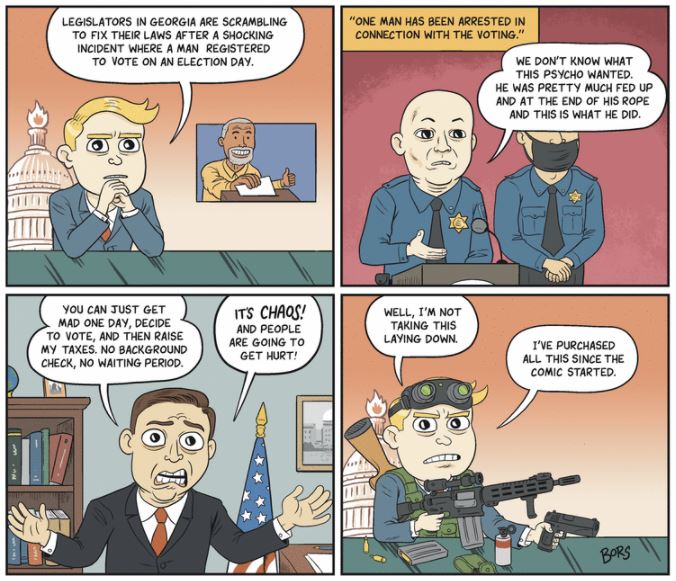
Voting horror in Georgia

Matt Bors

Juneteenth!

“We made Juneteenth a national holiday!”

“Great! How about that voting rights bill?”

“Didn’t you hear? Holiday!”

“And are you voting for the police reform act?”

“I don’t think you’re listening. National. Holiday.”

“(sigh)”

cartoon by Clay Bennett

Favorite “They Might Be Giants” animated videos

Two things I love: They Might Be Giants and good animation. So, for no other reason, here are some of my favorite animated videos of TMBG songs (that I could find on YouTube that were in good quality).