Editorial cartoon of the day

Top Ten Signs You’ve Got a Bad Trial Attorney

In anticipation of my trial tomorrow, I present:

THE TOP TEN SIGNS YOU’VE GOT A BAD TRIAL ATTORNEY

10. Constantly tweeting during the trial, and he’s not on Twitter

9. Requires every witness to answer in the form of a question

8. Asks if he can make a motion, and then does the Hokey-Pokey

7. Constantly says “If the glove don’t fit, you must acquit” no matter what the trial is about

6. Makes out with the District Attorney during breaks

5. All objections made by partner, Mr. Linty, a sock puppet

4. Uses air quotes when saying “Not Guilty”

3. Insists on doing his Pee-Wee Herman impersonation throughout entire trial

2. Gives closing argument in the form of an interpretive dance

1. Says “Wake me when it’s my turn to talk.”

Why is this news now?

Seriously … civil libertarians have been telling us for ten years that the Patriot Act allowed NSA to monitor phone calls of Americans. Many of us have spoken out against this intrusion, but were yelled down as being “terrorist sympathizers” and so on.

Now suddenly the program is being brought up as a terrible overreaching of the government.

Well, duh. Yeah, it is. It’s been that way since the Bush administration.

Then I started realizing who the biggest complainers were — the Republicans are attacking Obama with a vengeance over this. You remember the Republicans, don’t you? They’re the ones who wrote and passed the Patriot Act, and renewed it consistently.

Admittedly, some Democrats supported it, and still do, and some Republicans are not attacking Obama and are also defending the Patriot Act’s provisions. But, as Harry Reid said, “This is nothing particularly new.”

It’s only new to John Boehner who now apparently hates it (because he thinks he can make Obama look bad) despite having voted for it many times.

Editorial cartoon of the day

Supreme Court OKs internal searches without a warrant

The courts had previously ruled that taking of your blood for DNA purposes is basically a “search and seizure” protected by the 4th amendment and cannot be done without a warrant. Now that science has progressed to the point where cotton swabs of your saliva are enough, the Courts have said “Oh, well, that’s different” because, um, because we said so.

Apparently, your right to be free from a search doesn’t apply if the search is not bothersome. Clearly, therefore, if the police come into your house without a warrant and wear white gloves and put everything back afterwards, that would be just fine too.

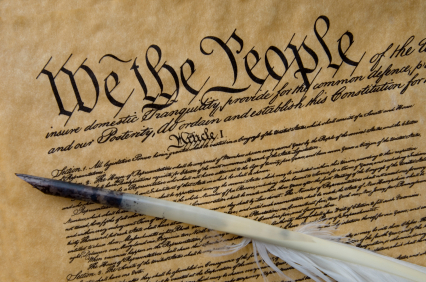
Stock Photo of the Consitution of the United States and Feather Quill

If you’re a cop and you think someone is a suspect and you need DNA, and you have probable cause, you can get a warrant for DNA. It’s done all the time. You go to see a judge, present your evidence, and the judge says yes or no. (And yes, good judges do say no from time to time. I’ve seen it happen.)

This case, however, was about getting DNA on anyone who gets arrested. No need to see a judge first to prove you have probable cause. So those cops who randomly stop minority kids in New York and arrest them on “loitering” or other minor charges? You can bet they’ll soon be carrying cotton swabs around with them.

So why is this a bad thing?

It’s bad because this is self-incrimination. You know, the thing prohibited in the 5th Amendment. You are being forced to provide evidence to the police against your will which could be much more incriminating than any confession. They don’t need your DNA for identification purposes — they already know who you are and can probably confirm that through your fingerprints — it’s being used to help build their case against you.

That’s the difference and that’s the problem.

Remember, we’re talking about people who are arrested, not convicted. Many people are arrested and never convicted. Sometimes the charges are never even filed. Once you are convicted, having to provide DNA as part of your probation requirements is perfectly valid, because you lose many rights once you’re convicted. This, however, takes away your rights before you are even charged.

The most surprising thing about this decision is that Scalia voted with the liberals. Every once in a while the voices in his head that he thinks are the Founding Fathers tell him the right thing, I suppose.

Lowering Blood Alcohol Levels to .05%?

There is a movement now to lower the level by which you can be convicted of drunk driving from .08% to .05%.

As a criminal defense attorney who handles a lot of DUI cases, I certainly have opinions on this.

The problem is that my opinion has a lot of “ifs.”gavel
First, let me explain the law. In Pennsylvania (where I practice), you can be driving perfectly fine, no problems whatsoever, but if you have more than .08% in your system, you can be found guilty of drunk driving. It’s a “per se” law which means that simply by having that much in your system you are guilty even if it did not affect your driving. I assume every other state is the same.

Obviously, alcohol affects everyone differently. One person can be drunk from two beers while another needs six, based on the size of the person and other factors.

So that law kind of bugs me, because you’re guilty even if the point of the law (to prevent drunk drivers) is not technically served.

On the other hand, people should not be driving after they’ve had a drink. Come on, why try to guess if you’ve had enough? Just don’t drink if you know you’ll be driving. (I’ve never been much of a drinker, but I’ve seen so many lives ruined from drunk driving that I don’t even have a sip if I know I am driving.)

So when I see studies showing that lowering the amount to .05% (which is the limit in a hundred other countries) results in less accidents, it’s hard to argue that we shouldn’t lower it.

The problem is this: In America, thanks to MADD and groups like that, the penalties for drunk driving are ridiculously harsh. Most states have a mandatory jail sentence for a first offense. (There’s not even a mandatory jail sentence for aggravated assault.) For a third offense in Pennsylvania, you could do a mandatory year in jail, even if your driving was perfectly fine, just because your BAC level was too high. A year! When I say people’s lives have been ruined because of drunk driving, I’m not just talking about the victims of accidents; most of the time, there is no accident.

I’d be willing to bet that in those countries that have reduced the rate to .05%, the penalties are nowhere near what we have. Penalties such as points on your license, a loss of license, and the requirement that you take alcohol classes (which we have now) may be sufficient to punish people without throwing them in jail, too.

So I may surprise people when I say that I am not necessarily against lowering the rate (and no, I’m not saying this so I can get more clients), but I would only support it if we got rid of mandatory prison sentences. (This is, in some way, a separate issue worthy of another blog post — one of the reasons the US has more prisoners than any other country is because instead of treating addicts, we imprison them.)
Plea Bargaining and Justice

Not too long ago I found myself facing two jury trials, one after the other, both with the same DA. We spoke about them and agreed that I’d probably win the first one and he would probably win the second one.

The exact opposite happened.justice

And that’s why most cases never go to trial … because everything is a gamble. Both sides would rather have something definite than gamble.

Some people who have no experience with the legal system have a strange idea that plea bargaining does not promote justice, when in fact it works just fine. The District Attorney asks for something way over here, I counter with something way over there, and when we meet in the middle — well, that’s probably where justice is.

Sometimes you have to go to trial. I refuse to take plea deals when they are no better than what I would get if my client would be found guilty. (This is especially true in very serious cases like murder or rape.) And sometimes my client insists on a trial, and the client’s wishes always prevail.

I advise all my clients though that every trial is a gamble. I’ve won cases I was sure I’d lose and lost cases I was sure I’d win, and every lawyer will tell you the same thing. They’ve even done social experiments where two separate juries have watched the exact same trial and have produced completely different verdicts.

Don’t get me wrong — it’s still the best system in the world. But no one should ever think that justice is perfect, that the good guys always win and the bad guys always lose, and that juries are never wrong.

(That’s one of the main reasons I am against the death penalty — I don’t believe there should be a penalty that is 100% irreversible when we don’t have a system that is 100% perfect.)

I went to court this morning ready for trial but my client decided at the very last minute to take the plea I had worked out for him months ago. He finally decided he wasn’t ready to gamble.

How do I feel about that, you ask? Well, personally, I like doing trials, and I like winning. I don’t mind the gamble.

But I’m not the guy going to jail if I lose. And that’s why it is ultimately up to my client to decide.