
The courts had previously ruled that taking of your blood for DNA purposes is basically a “search and seizure” protected by the 4th amendment and cannot be done without a warrant. Now that science has progressed to the point where cotton swabs of your saliva are enough, the Courts have said “Oh, well, that’s different” because, um, because we said so.
Apparently, your right to be free from a search doesn’t apply if the search is not bothersome. Clearly, therefore, if the police come into your house without a warrant and wear white gloves and put everything back afterwards, that would be just fine too.
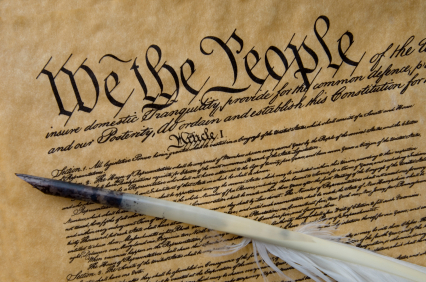
If you’re a cop and you think someone is a suspect and you need DNA, and you have probable cause, you can get a warrant for DNA. It’s done all the time. You go to see a judge, present your evidence, and the judge says yes or no. (And yes, good judges do say no from time to time. I’ve seen it happen.)
This case, however, was about getting DNA on anyone who gets arrested. No need to see a judge first to prove you have probable cause. So those cops who randomly stop minority kids in New York and arrest them on “loitering” or other minor charges? You can bet they’ll soon be carrying cotton swabs around with them.
So why is this a bad thing?
It’s bad because this is self-incrimination. You know, the thing prohibited in the 5th Amendment. You are being forced to provide evidence to the police against your will which could be much more incriminating than any confession. They don’t need your DNA for identification purposes — they already know who you are and can probably confirm that through your fingerprints — it’s being used to help build their case against you.
That’s the difference and that’s the problem.
Remember, we’re talking about people who are arrested, not convicted. Many people are arrested and never convicted. Sometimes the charges are never even filed. Once you are convicted, having to provide DNA as part of your probation requirements is perfectly valid, because you lose many rights once you’re convicted. This, however, takes away your rights before you are even charged.
The most surprising thing about this decision is that Scalia voted with the liberals. Every once in a while the voices in his head that he thinks are the Founding Fathers tell him the right thing, I suppose.
 ventrellaquest.com
Ostensibly, the Court established a new, ill-defined standard:
“When officers make an arrest supported by probable cause to hold for a serious offense,” wrote Kennedy.
What exactly is a serious offense?
And how exactly does a swab differ from the blood sample taken in Missouri vs. McNeely? “”Neely refused to consent to the blood test, but the officer directed a lab technician to take a sample.”
and
“This case, the state court found, involved a routine DWI investigation where no factors other than the natural dissipation of blood alcohol suggested that there was an emergency, and, thus, the nonconsensual warrantless test violated McNeely’s right to be free from unreasonable searches of his person.”
Click to access 11-1425_cb8e.pdf
Monday!
I don’t get it. And I don’t get Breyer’s vote in either case.
LikeLike
Mike, I feel like you need to elaborate more. How is this any different than taking fingerprints, which is currently allowed, on arrest, without a warrant, and remains permanently on file? Unless I am missing something big, the methodology and purpose of fingerprinting and DNA testing seems to be incredibly similar.
LikeLike
Mike Strauss –
I already identified the difference, as it is presented in this case: a fingerprint does not require one to provide access to one’s mouth or other orifice.
Further, in this case the DNA was not being used for identification, but for cross-checking for prior cases.
Given that the majority granted that this was a search, as I noted above, I don’t see how it is significantly different from the blood sample case decided Monday.
LikeLike
Josh, I don’t think your explanation between taking fingerprints and DNA is completely valid. An unwilling suspect can be legally compelled to provide fingerprints, which is to say, forcefully. That could certainly be construed as an invasion of privacy, but is not.
Unless you’re make the distinction solely on the inside/outside of a person’s body? In that case, any bodily fluids outside a person’s body, such as blood from a wound, spitting, or just waiting for them to urinate, is a valid source of DNA in the correct circumstances. Does DNA collection then fall into the same category as fingerprints? Does this mean that DNA should be allowed? Or fingerprinting disallowed?
Our society is falling into a “security > freedom” mindset, which comes with a price. DNA on file makes it easier to find those who perpetrated past crimes. National gun registration makes it easier to find those who may one day commit a crime with that gun, though they are innocent now. Both can be means of further securing the safety of the people and have their proponents. However, both are also invasions of privacy and freedoms and have their opponents. (And no, Mike Ventralla, I do NOT buy into the “registering a gun is just like having a driver’s license comparison. First, driving is not a constitutional right. Second, the reason why a national gun registration is being pushed so hard now is because of recent past atrocities, so motivation is just like fingerprinting and DNA collection; to keep tabs on “suspects”; i.e. gun owners.)
As soon as words like “national file/registry/database” show up, flags should immediately be raised, and the first question asked should be, “For what purpose?” And immediately on the heels of that question should be the next: “How can this be used in other, more invasive ways?” And the automatic third question is, “What is the price in freedom that must be paid for this security, and am I willing to have our country pay that price in freedom?” I’m not saying it may or may not be justified; I’m simply saying we need to examine each one, compare them to other similar situations, and decide on if we want to give up some freedoms for that security.
And the oft quoted is appropriate here to ponder on:
“Those who would give up essential Liberty, to purchase a little temporary Safety, deserve neither Liberty nor Safety.” BENJAMIN FRANKLIN, Pennsylvania Assembly: Reply to the Governor, November 11, 1755.—The Papers of Benjamin Franklin, ed. Leonard W. Labaree, vol. 6, p. 242 (1963).
LikeLike
As far as I know, the acquisition of fingerprints *and* of DNA that are left behind is common practice.
But yes, I was drawing a very intentional distinction between inside and outside, Peter. The police may inspect the outside of your house, but they cannot go in without a warrant or probable cause. They can use blood left behind, but they cannot just demand your blood be drawn because they want it for evidence.
I think in the case of DNA from splattered blood or hair on the floor or whatever, that it falls into the classification of evidence legally obtained (assuming no illegal entry, of course). Lifted fingerprints are the same. Taken fingerprints as a form of identification make some sense – but if they want more proof of ID than the finger prints, then why not go for retinal scans?
Because the DNA is a better fishing tool! And it is the fishing function to which I object (in addition to the warrantless search).
I don’t need a national gun registry, though I understand the attraction. I need the guns to be harder for non-owners to fire. I need them to be harder to shoot for children. I need them to be harder to massacre people with. Any one of those would be a good start.
You said “And the automatic third question is, “What is the price in freedom that must be paid for this security, and am I willing to have our country pay that price in freedom?””
To me, then, the semi-automatic fourth question (with the 30 round clip) is, “If I am unwilling to have our country pay that price in freedom, what am I willing to do about it?
LikeLike