Viruses evolve, which is why we get new ones all the time.
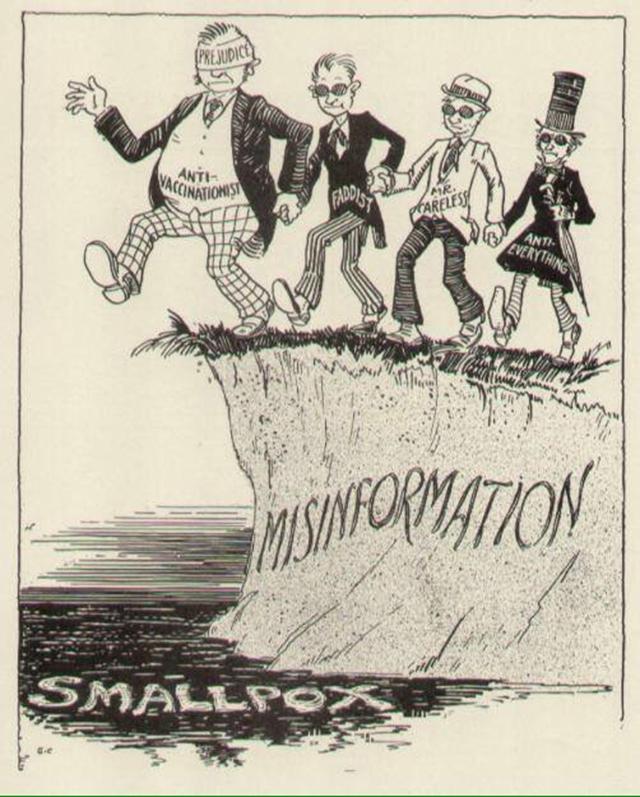
But they can only spread if people spread them. They can’t travel by themselves. Had everyone worn masks, gotten vaccinated, and stayed apart, the virus would have died on its own. Instead, the refusal of people to take even the simplest precautions only helped it grow and mutate.
It’s very easy to see who to blame for this. And my sympathy for those who are stubborn and refuse to take care of themselves and others is waning daily.
Seriously. Being a Democrat is hard. We have to stand for things and mean it, and our voters hold us to what we say.
How much easier it is to be a Republican. Just think about it. You don’t have to stand for anything.
You can say you’re against huge deficits, and then once elected, create deficits higher than any Democrat.
You can scream that “Blue Lives Matter” but look the other way as your own supporters brutally attack cops.
You can claim to love America while waving a Confederate flag.
You can talk about how a Democratic president shouldn’t be allowed to name a Supreme Court justice in an election year and then rush your own nominee through while voting has already begun.
You can be completely in favor of mail-in voting until you realize more Democrats use it than Republicans, and then you can be completely against it.
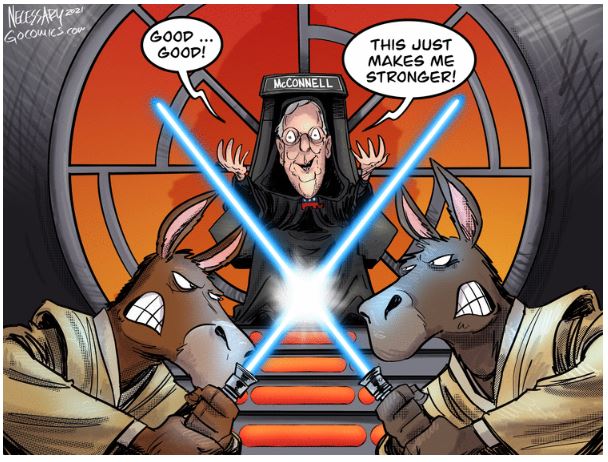
You can talk about how important the filibuster rule is and then you can ignore it when you’re in charge and want something passed.
You can claim to be the party of “family values” while supporting politicians who cheat on their wives and pay porn stars for sex.
You can support an employment-based health care program until a Democrat proposes it, and then you can be completely against it.
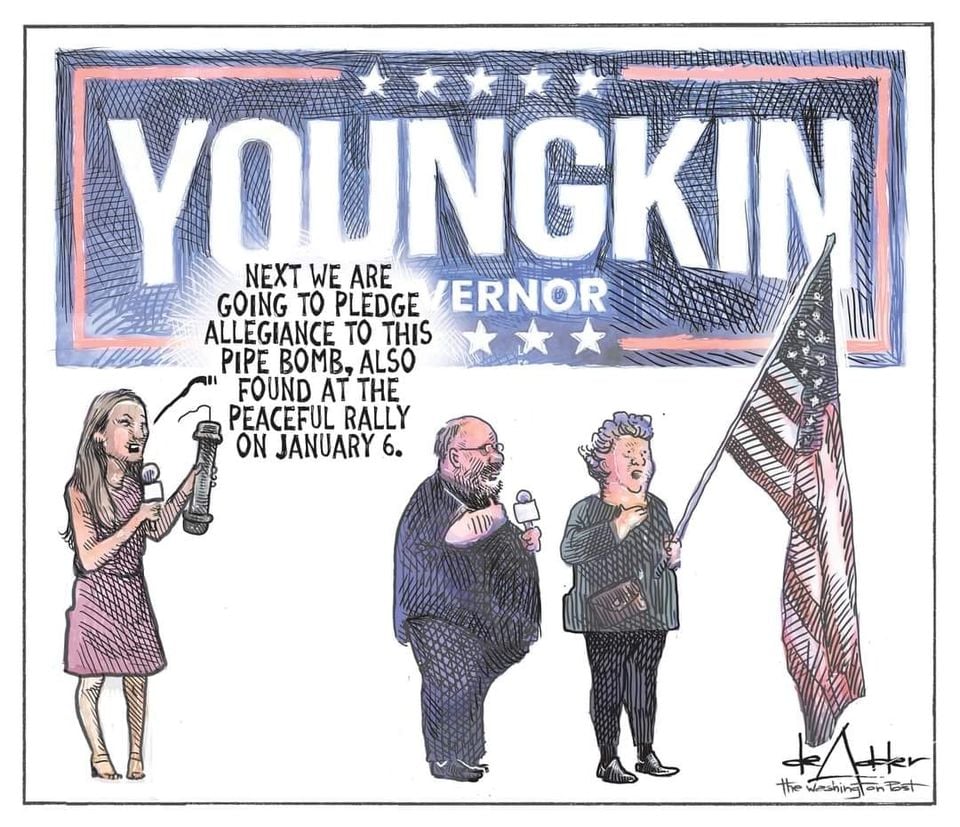
You can refuse to support a bill setting up a bipartisan committee to investigate the January 6th insurrection and then when Democrats do it anyway without you, you can criticize them for not being bipartisan.
You can talk about how you need to get government off the backs of Americans while at the same time telling people who they can and can’t marry and what they can do with their own bodies.
There are many more examples, of course. These are just off the top of my head. (Feel free to add your own in the comments.)
Life would be so much easier if I were a Republican. I’d never have to worry about anything I said, because I could do the exact opposite the next minute and other Republicans would have no problem with me doing that.
You ever notice that the people who complain about “political correctness” are never the ones that need correcting?
“I can’t believe they’re changing the Cleveland Indians to the Guardians!” a bunch of non-Native Americans are screaming. “How dare they get rid of Aunt Jemima!” say white people. “Changing fictional characters to become women is ridiculous!” say men.
“What do you mean I can’t use an insulting term about someone different than me?” they say. “That’s ridiculous. Those terms never bothered me any, so why is everyone else upset?”
Because it’s not about you. It’s true. I know, I know — sit down and consider the following concepts:
Other people exist in the world
They have opinions, too
They are experts about their own identity, not you
If they say something is insulting to them, you should listen
You are impressing no one with your stubborn refusal to change
“Let’s have a bipartisan committee to look into the January 6th insurrection.”
“No! We Republicans vote no!”
“Fine, then we Democrats will do it on our own — but because we’re nice guys, we’ll allow you put some of your people on the committee even though we don’t have to.”
“In that case, we Republicans want you to put some of the actual people who helped the insurrectionists and think the whole thing was caused by Antifa, because we have every intention of turning this thing into a sham if at all possible. After all, our stated goal has always been to obstruct every damned thing you try to accomplish.”
“No, we’re not going to do that. They can’t be on the commitee.”
“You see? The Democrats don’t care about bipartisanship!”
Whenever something bad happens in some totalitarian government, the right is the first to scream that the problem is “socialism.”
They conveniently ignore all the democratic countries that are primarily socialist and instead look at the few that are run by dictators. “Look how bad Venezuela is!” they scream. “Clearly, it’s because of their socialist policies and not at all because they have a terrible dictator running things.” The fact that most of Europe, Canada and Japan have socialist economies of varying degrees doesn’t convince them. It has to be socialism! It can’t be the evil dictators!
Now, admittedly, given right-wing support of oppressive governments like Russia and what Trump wanted to turn the U.S. into, you can sort of understand their obsession of finding another reason for a country’s failure than authoritarianism. But mostly it’s just a misunderstanding of the distinction between a government and its economy.
(Current protesters in Cuba, who have specifically said it’s the dictatorship they are protesting, not socialism. Not that facts matter to the right.)
Here’s a very short abbreviated version of the difference:
Economic
Capitalism. This is where the market decides and government stays out of it. No minimum wage, no health inspections, no laws against discrimination, no regulations on business at all. This doesn’t work, because you end up with the powerful running everything, destroying the economy, and keeping people in poverty.
Communism. This is where the government runs business. The idea is that we should all live together in peace and harmony and share everything, and the President earns the same amount as the guy who sweeps the street. This also doesn’t work, because it completely destroys initiative and any reason to try to improve yourself.
Socialism. This is where most countries are, where the government regulates business to prevent the abuses capitalism can bring, and provides many services (libraries, hospitals, parks, fire departments, social security, unemployment, etc.) This is the tough balance to meet. You don’t want to go too far in either direction, and most of the debate in the US is over how far to go.
Political
Democracy. This is where the people decide, usually through representative democracy or republicanism.
Totalitarianism. This is a dictatorship, whether individually controlled (North Korea) or committee controlled (China). Once more, there are degrees here as well as various types (monarchy, fascism, oligarchy). But the key thing they all have in common is that the decision-making power is not with the people.
So happens is that people confuse the economic with the political. The Soviet Union was a communist country but was also a totalitarian country. Cuba has a socialist economy but is a dictatorship. It is possible to have a democracy that is communist if the people vote for it, and it’s also possible for a totalitarian capitalist country.
It’s even more confusing when countries lie about themselves. Just because you call yourself “the Democratic Republic of Vietnam” doesn’t mean you are a democratic republic, any more than China is the “people’s republic.” The Soviet Union was indeed a communist country, but it was a corrupt one because you know perfectly well that not everyone shared equally in that society.
So whenever some right-wing fool tries to blame terrible conditions in a country on “socialism,” take it with a grain of salt. Could socialism be part of the problem? Sure, if poorly managed. So can capitalism. But when the real reason is a terrible dictatorship, you don’t have to ignore that to find a scapegoat you’re more comfortable with.