President Ahnold will Terminate the Constitution

Republicans hate immigrants, clearly. They come here and steal all our jobs (like actor and Governor).

And if there is one thing they really hate, it’s when foreigners aren’t born in ‘Murica. That Kenyan-born guy, for instance. Should never have been President. There’s a reason the founders required all Presidents to have been born on American soil.

What’s that? Ted Cruz, born in Canada, wants to be President? And now Arnold Schwarzenegger, born in Austria?

Well, that’s an elephant of a different color! Ahnold would be a great President, they say. (Let’s leave out the part where, under Arnold, California went into terrible debt and how, in the few years since the Democrats took over, it has turned itself around and now has a budget surplus.) pd_arnold_schwarzenegger_conan_jef_121026_wmain

Ahnold now says he wants to run in 2016, where he will his crush his enemies, see them driven before him, and hear the lamentation of the Democrats. He says he will “file legal paperwork to change the rules” to allow him to run.

I am not making this up. A man who wants to be President knows so little about the United States Constitution that he thinks he can “file legal paperwork” and get to run.

The only way he could do this is by changing the Constitution, which requires 2/3rds of both the House and the Senate to approve of the wording of the amendment, and then 2/3rds of the states to pass it. And he only has a few years in which to do it. He’ll have a big problem convincing a Senate controlled by Democrats to give him what he wants.

Mind you, I think the Constitution should be changed in many ways, and this is one of them. There is no reason someone born in another country shouldn’t be able to run for President. Maybe Arnold’s quest may allow this to finally happen — but after the election, when it won’t benefit him personally.

Strict Scrutiny (part four): Exceptions to the 2nd amendment

Constitutional fundamentalists, like religious fundamentalists, yell the loudest when their pet issue is involved.  Suddenly, all compromise and nuances go out the door, because they believe there is One Right Answer and they, and they alone, are wise enough to see what that answer is.

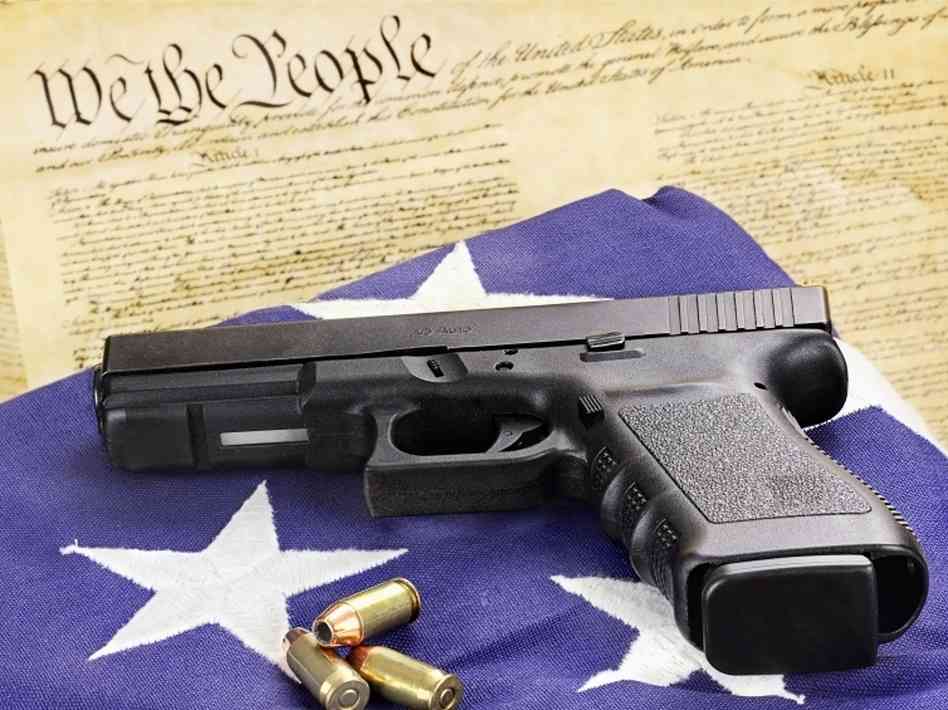
These people will gladly agree to gray areas in other parts of their particular Document That Cannot Be Interpreted (whether their holy book or the Constitution) but don’t you dare misinterpret the intent of (insert one:  God / Founding Fathers) when it comes to (insert one:  abortion / gun control). gun

Many people who read the Constitution so strictly as to never allow any gun control will agree that the 1st amendment, despite being very clearly written, has many exceptions that seem to negate the words “Congress shall make no law abridging Freedom of Speech”.  “It’s all how you interpret ‘abridging,’ they will say.

So let’s look now to the poorly-written 2nd amendment:

A well regulated Militia, being necessary to the security of a free State, the right of the people to keep and bear Arms, shall not be infringed.

That’s the version from the National Archives that just about everyone uses.  But then here’s the version from Thomas Jefferson’s writings — the official version passed by the Senate:

A well regulated militia being necessary to the security of a free state, the right of the people to keep and bear arms shall not be infringed.

Less commas.  But that can make a difference, especially if you are trying to figure out whether the amendment applies to “militia” or “people.”

I am not going to spend this entire post on every nuance of the 2nd amendment because that would take a book.  I advise you to read the first three parts of this current series.  The point of this series is to show that the Constitution is not written in stone, is a result of political compromises, and all parts need to be interpreted.

The 2nd is no exception. It’s not like the rest of the Constitution was written after debates and subject to deals whereas the 2nd was agreed upon by everyone off the bat.

There’s plenty of historical documentation to establish that the 2nd was another one of those Constitutional bits, like the 3/5th clause and other slavery provisions, added because the southern states demanded it. An original version did not use the words “free state” and those words are there for a reason — because the states wanted to make sure they could keep their “militia” which were used to round up escaped slaves. Seriously, there are writings from Patrick Henry and George Mason worried that the northern states, unable to stop slavery, would instead take the guns away from the people keeping the slaves in their place. Whether this was the main reason or not, it still supports my point that the amendment was a compromise.

If you want to be a purist, like many Constitutional fundamentalists claim to be, then I can argue that the Founding Fathers meant only for you to have the right to own guns that could only hold one bullet at a time, took a minute to load, and blew up in your face much of the time. “Of course they didn’t mean that!” they respond. “Ah!” I reply. “So you had to interpret it to include modern firearms.”

The 2nd amendment, just like all of the Constitution, doesn’t mean the same thing it did when it was written. For most of our history, the Supreme Court held that it applied to militia. It was not until the court decided Heller a few years ago that it became an individual right, which countered past history and was strongly objected to by four members of the Supreme Court. (That’s right — one justice made all the difference as to what the Constitution means.) Even still, Heller allowed for regulations of firearms. (That’s the part they forget to tell you most of the time.)

There is nothing magical about anything in the Constitution that leaves it free from interpretation. When I debate the 2nd amendment with Constitutional fundamentalists who believe that the 2nd is written in such a way as to prohibit any gun control whatsoever, the conversation usually goes like this:

“So you don’t think we should keep guns out of the hands of terrorists, criminals, the insane, and children?”

“No, that’s different.”

“Ah! So you agree with me that the amendment is not absolute and there are exceptions! Good. We only disagree on what those exceptions should be.”

I’m not going to spend this post on what I think they should be. My only point is that the amendment is not absolute and is subject to interpretation — just like every other part of the Constitution.

Strict Scrutiny (part three): 1st Amendment Exceptions

The 1st Amendment is written about as clear and concise as can be.  No exceptions are provided:

Congress shall make no law respecting an establishment of religion, or prohibiting the free exercise thereof; or abridging the freedom of speech, or of the press; or the right of the people peaceably to assemble, and to petition the Government for a redress of grievances.

That’s five really important rights all tucked into one small sentence. Freedom of Speech Freedom to establish a religion;  freedom to exercise your religion;  freedom of speech;  freedom of the press;  freedom to protest.

Constitutional fundamentalists read the Constitution strictly and argue that one must never interpret the document or read something into it that isn’t there.

Let’s take Freedom of Speech as an example.  Clear as day, right?  No interpretation needed.  No exceptions are allowed.

Here’s where we pause for laughter.

There are lots of exceptions to your right to free speech, and these are exceptions that just about everyone will agree are a good idea.  Most of these exceptions existed when the Constitution was written.  For example:

Time, Place, and Manner.  Your right to speech can be limited as to when and how you can exercise it.  You can’t stand in the middle of a courtroom during a trial and give a speech about taxation.  You can’t have a rally at 3 am using loudspeakers.  You can’t disrupt a military funeral claiming that “God hates fags.”  The time, place, and manner of your speech can be regulated.

Clear and Present Danger.  You have the right to speak out against the government, but if you’re inciting a riot, you can be stopped and you can’t claim they are violating your right to speak.  (It’s not the speech they are stopping, after all, it’s the violence you are encouraging.)

Defamation.  Libel and slander are not protected.  You cannot commit these crimes and then claim, in your defense, that the 1st amendment protects you.

Obscenity.  Obscene works are not protected, although there are very few cases about obscenity these days because of the proliferation of adult websites.  Still, the exception is there.  This is different from Child Pornography.  Things that would not be considered obscene if it involved adults would still be prohibited if children are involved.   In a sense, when you are convicted of child pornography, it’s because you are conspiring in the assault on the child.  (That’s the key — artwork featuring children is not prohibited, for instance, although I certainly wouldn’t want to have anything to do with you if that was the kind of thing you enjoyed.)

Commercial speech.  Advertisements can be regulated.  You can be punished for making false claims about your product and you can’t claim in your defense that your 1st amendment rights were violated.

Reasonable governmental interests.  You can’t reveal government secrets that would place our agents or troops in danger.  You don’t have absolute freedom to publish whatever you want in a school newspaper.  Radio and television airwaves can be regulated.  If you’re a government employee, you may be limited in what you can say about politics.  Your speech can be limited when you are in the military or in jail.  The government can restrict what lawyers can say.  (Seriously, we can be punished for violating our ethical requirements by revealing confidential information, for instance.)

Anyway, I could spend an entire semester on these exceptions (and did, when I was in law school).

And this is just for the Freedom of Speech part of the 1st Amendment.  I haven’t even mentioned the other rights in the 1st, all of which have exceptions.

“But wait,” you say.  “What about governmental secrets that don’t place anyone in danger, like in Snowden’s case?  What about restrictions on time, place and manner that are unreasonable?  What if I disagree with the government as to what is obscene?”

Aha.  Now you see why we need courts and lawyers.  Every case is different, and there are many shades of gray in the law.  What applies in one case may not in the next.

And that is why you must laugh at any Constitutional fundamentalist who proclaims that there is one right answer for every circumstance and that the Constitution does not need any interpretation.

Part four next:  If there are this many exceptions to just one part of the clearly-worded 1st amendment, why can’t there be exceptions to the poorly-worded 2nd amendment (especially since it’s the only amendment that contains the words “well-regulated”?)

Click here to read part one and start at the beginning.

 

Strict Scrutiny (part two): Constitutional Compromises

The Constitution is a series of compromises, and not a document of Wisdom Handed Down from Our Elders.

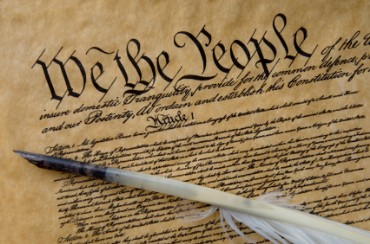
In order to get the Constitution ratified, certain concessions had to be made.  In part one, I mentioned how many parts were written purposely vague because that was the only way to get agreement on them. Let’s now look at some more clear-cut examples.constitution_quill_pen

The most obvious may be “The Virginia Compromise.” (Look, it even has “compromise” in its name.) The smaller states wanted each state to have an equal vote so that they wouldn’t be ignored. The larger states wanted it to be based on population which would obviously benefit them. In the end, we got both — a Senate where each state gets the same representation no matter how small, and a House where the states with more people get more representation.

Then there are the first ten amendments themselves (the “Bill of Rights”). Many states refused to ratify the Constitution without these protections, and it’s a good thing they demanded them.

But the clearest example of compromise in the Constitution has to do with slavery. Most of the northern states had already abolished it and wanted the entire country to do the same, but the southern states refused. The south was worried that as soon as this Constitution was passed, the northern states would outlaw slavery completely. Without some provisions to prevent this, the south refused to agree to the Constitution.

Rather than split the country within the first ten years of its existence, a series of compromises were worked out. (Sadly, postponing this only led to the bloodiest war in American history a hundred years later.)

First, there’s Article I section 9 which specifically prohibited Congress from passing any law outlawing the importing of slaves before 1808 (twenty years from the Constitution’s signing). Why 1808? Was there something magical about that year? No, that was just the number that compromise produced. (And as soon as 1808 came about, Congress did exactly what the south was worried about and banished the importation of any more slaves.)

Second, there’s the ridiculous 3/5ths clause. The south demanded that when determining how many representatives they would get in the House, that slaves should be counted as “people” even when they were property in every other respect under the law. The north rightly pointed out how stupid this was, but the south insisted and there was another compromise made. We ended up with a provision that held that 3/5ths of every slave would count. No mention as to which 3/5th of the slave counted, though, but apparently it didn’t include the head since the views of the slaves mattered not.

Third, there’s the 2nd Amendment, which allowed the southern states to keep their state “militias” which were basically armed gangs whose only job it was to intimidate slaves and capture ones who escaped. (More on this later.)

So whenever some Constitutional fundamentalist tries to argue with you that the Constitution is concise and “the will of the Founders,” just point out how many compromises there are in it, thus clearly indicating that there is no “will of the Founders.” It’s all agreements and compromises needed to get the thing passed.

Next: A clear, exact 1st Amendment which doesn’t provide for any exceptions, and then all the exceptions there are to it.

Strict Scrutiny (part one): Constitution Fundamentalists

There are religious fundamentalists out there who are convinced that they know exactly what the Bible says.  They take it absolutely literally and have no doubt in their mind what it all means, and anyone who disagrees with their interpretation is simply wrong.  And, amazingly, what the Bible says matches their own personal views perfectly!

There are Constitutional fundamentalists who have the same view — they treat the Constitution like it was written on stone tablets and handed down by the gods.  Sadly, at least one of these fundamentalists is on the Supreme Court.

The problem with this simplistic view is that it fails to take into consideration Constitutional history and common sense.  The Constitution was written by men, not gods, and they did not all agree on the meaning of the words or what should be in there.  constitution_quill_penThere is no more of a “founder’s intent” than there is a government intent on any bill.  Will people years from now claim that the entire Congress agreed unanimously on Obamacare?  Of course not.  So why do people insist on believing that for the Constitution?

The Constitution is a series of compromises, just like everything done by government.   It was written very broadly, with purposely vague words, because that was the only way it could get passed.  It’s meant to be our guidelines for how the laws will be written — our goals, if you will.  It was not meant to be taken literally to the point where there is only one interpretation.

Those who say that there is just one way to interpret it need to explain why, within a few years, there were Supreme Court decisions about it.  These were the exact same people who wrote the damn thing — why would they need to go to court to have someone explain it to them?

One of the first and most important Supreme Court decisions in those early years was Marbury v. Madison, in which the Supreme Court said that they have the right to review laws to determine whether they were Constitutional.  Makes sense, right?  Who else would do that?  But those words aren’t anywhere in the Constitution.  The founding fathers had to interpret them from the overall document.  And clearly, not everyone agreed.  And these were the people who wrote it!

After all, if everyone agreed on the meaning, there would be no need for a Supreme Court at all.

You’d think people would get that, but Constitutional fundamentalists (who, like religious fundamentalists, are always very conservative) cannot accept this.  Justice Scalia, for instance, chides his fellow Justices all the time for getting it “wrong” when they refuse to acknowledge he has super powers to read the minds of the Founding Fathers and know exactly, for instance, what their views were on internet regulations.

Part two:  Examples of compromises made by the Founders

Pledge Against Your Will — For Freedom!

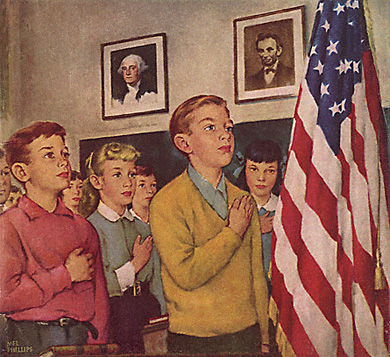
A Florida teacher has been suspended for five days without pay after forcing her students to say the Pledge of Allegiance. And rightly so.

“You are an American, and you are supposed to salute the flag,” she said. Pledge-of-Allegiance“In my classroom, everyone will do the pledge; no religion says that you can’t do the pledge. If you can’t put your hand on your heart, then you need to move out of the country.”

Such a patriotic attitude! (Insert comic German accent) “You vill obey und salute the government. Ve do not appreciate individual thought here!”

She still doesn’t understand what all the fuss is about, which means maybe this teacher should go back to school and take a remedial social studies class.

This is America — where we don’t force people to love the government. After all, of what use is a forced pledge? If someone forces you to say something against your will, what’s the point? How is it meaningful? Does the irony not hit people? “We are forcing you to pledge against your will — for freedom!!!”

The United States Supreme Court held that no one could be forced to say the pledge over fifty years ago in a case involving the Jehovah’s Witnesses, who persuasively argued that such a pledge violated their religious beliefs concerning worshiping objects or something. The child who this teacher forced to say the pledge was a Jehovah’s Witness, which makes this Florida teacher’s decision even worse.

I am always amused by patriots who want to force Americans to do things like this — which seem to me to be one of the most unAmerican thing you can do. Say the pledge because you mean it, and not because you have to. That’s true patriotism.

The Constitution and War

When the Constitution was written, war was a lot simpler — for one thing, it took a long time. You had to move armies and ships and supplies and well, this just wasn’t done overnight.

So the Founding Fathers, wary of letting the President have too much power as Commander-in-Chief, wrote Article I, Section 8, which gave Congress the power to “declare war.”Stock Photo of the Consitution of the United States and Feather Quill

They haven’t done that since World War II.

So now Obama is about to take actions against Syria that, by any standard, is an act of “war”. But we’ve allowed our Presidents to do this so many times that no one is seriously suggesting that this is unConstitutional any more. (Well, except for the Obama haters, most of whom had absolutely no problem with GW Bush doing the same thing, so we can ignore them.)

But it’s still not that simple. The Constitution does not define what a “war” is or what the process is for Congress to declare it, nor does it prevent the President as Commander-in-Chief from ordering troops anywhere he wants and so on.

During Vietnam, Congress passed the War Powers Act which severely limited the President’s power to keep troops somewhere without congressional approval. It has not been enforced since then.

On the other hand, Congress did approve Presidential actions in Iraq and Afghanistan even though they never officially called it a “war.”

Then there’s the question of treaties. If this is done with UN approval, maybe foreign treaties take precedence over the Constitution, like when we went into Libya. (Well, with drones.)

So as our President becomes more and more imperial during wartime, we seem to be sitting back and going along for the ride.

This is especially disturbing right now with Syria, because a vast majority of Americans want us to stay away from that terrible place (How often do you get 75% of Americans to agree on anything?).

I’d say this is a perfect time for Congress to step in and say “no” to the President, but sadly the vast majority of Congress is in agreement with him.

World’s easiest law school exam question

You don’t even have to go to law school to get this one right:

Is it Constitutional for the police to randomly stop people on the street and search them?

I mean, duh, you’d have to be really stupid to get that one wrong, wouldn’t you?

Well, I suppose you could be the Mayor of New York. Or a bunch of people who apparently have never taken the time to read the Constitution.

But a court recently ruled in a “No, duh” decision, that New York city’s policy of randomly stopping young black men and searching them for no reason was not allowed.

Sadly, I wish they’d go farther. The 4th Amendment says “The right of the people to be secure in their persons, houses, papers, and effects, against unreasonable searches and seizures, shall not be violated, and no Warrants shall issue, but upon probable cause, supported by Oath or affirmation, and particularly describing the place to be searched, and the persons or things to be seized.”police car

Requires a warrant. Clear and plain as day. No exceptions listed.

The courts, of course, have found exceptions to this all over the place, the most obvious one being that police can search if they have “reasonable suspicion” that a crime is being committed or that the suspect is armed and so on. The general idea of “reasonable suspicion” is not bad — I don’t mind letting police search someone for their own safety after an arrest — don’t want to waste time getting a warrant in every single instance. But that has been defined in such a way lately that they can search in almost every instance. The next logical step was, of course, a policy like New York city’s, which, for quite some time, was perfectly legal.

Mayor Bloomberg, meanwhile, said he’d appeal, so this isn’t over. Your tax dollars at work.

He’s not the Messiah!

Some people just name their kids really stupid things that can haunt them for lives.

But when someone in Tennessee named their kid “Messiah,” that was too much for a judge. “The word Messiah is a title and it’s a title that has only been earned by one person and that one person is Jesus Christ,” she said.

Good thing that judge wasn’t around in 1958 when Madonna’s parents were deciding on a name.

So the judge, over the parent’s objection, changed the child’s name, like a magical fairy.

I mean, while I certainly don’t want parents naming their kids “Hitler” or “Asshole,” I also don’t like the idea of the government coming in and deciding for the parents what the child’s name should be.

And it’s especially true here, where the reason for the name change was religion. That judge just didn’t want her personal religion made fun of, apparently.

Hey, wait, wasn’t there a Constitutional Amendment prohibiting this sort of thing? Like, the very first one?

DOMA Arigato

The defeat of DOMA is an important step, but the battle for justice and equality is never-ending. Thanks to the Court, someone can now get married in a state that doesn’t discriminate, move elsewhere, and still be able to get federal benefits such as joint tax filing and so on.

I’m sure I’ll have more to say about it later, but for now, I’m celebrating. After all, I have to — according to many religious fanatics, my 30 year heterosexual marriage is in danger of collapse because of this.