By Guest blogger Terri Lynn Coop
June 26, 2015 was one of those days when the wheel of history turned. At the center of the social media celebration and barrage of rainbows is the 35-page opinion on marriage equality penned by Justice Kennedy.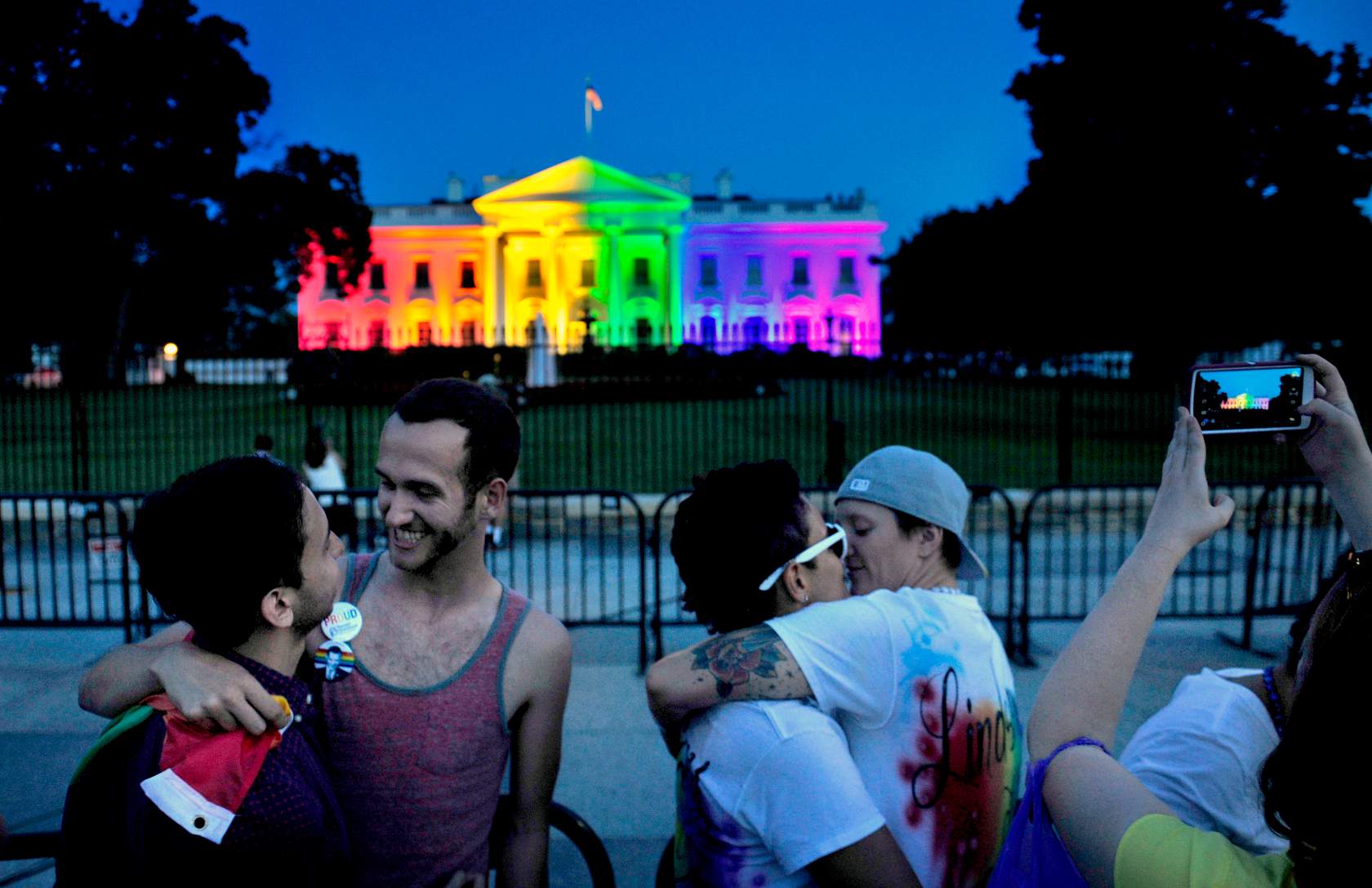
As both a lawyer and an ally, I find the opinion to be succinct, elegant, iron-clad, and a doorway to further equal rights activism here in the good old USA. After I held a series of light-hearted law “lectures” on the subject on Facebook, Mike invited me here to the ‘Quest to take a look at some of the key parts, both obvious and less so, of the opinion.
Overall, the Court grounded the opinion firmly in the 14th Amendment rights of Due Process and Equal Protection under the law. Out of that principle has sprung the right to privacy in what the court calls “intimate relations.” Kennedy went straight to the keystone cases such as Loving that struck down racial bans on marriage and Griswold that protects the right of married people to use contraceptives (yeah, that had to be litigated).
“This Court has invoked equal protection principles to invalidate laws imposing sex-based inequality on marriage . . . and confirmed the relation between liberty and equality . . .”
Strong words right there. We can’t have personal liberty without equality.
“The right to marry is a fundamental right inherent in the liberty of the person, and under the Due Process and Equal Protection Clauses of the Fourteenth Amendment couples of the same sex may not be deprived of that right and that liberty.”
Part of deciphering judicial opinions is to look for the key words and phrases. Here it is “may not.” In other words – NO. No as in Grumpy Cat NO. Nyet. No way, no how are same-sex couples to be deprived of the fundamental civil right to marry.
The Court went on, conflating liberty and personal identity:
“The fundamental liberties protected by this Clause include most of the rights enumerated in the Bill of Rights . . . In addition these liberties extend to certain personal choices central to individual dignity and autonomy, including intimate choices that define personal identity and beliefs.”
The Court has just connected being gay with personal identity, autonomy, dignity, and civil rights. That sets up a key statement from later on in the opinion.
This Court is heavy on precedent. It is a thread through their decisions. This Court backed this pronouncement up with three cases where marriage rights were affirmed for mixed-race couples, prison inmates, and men who were behind in child support cases. Bottom line, other than the requirements that the parties be of age, of mental competency, and not related by a certain degree of marriage or blood, American citizens have the right to marry whoever they want to.
Answering the “traditional marriage” naysayers, the Court held that times change. Society changes and marriage has changed. Traditionally, women were essentially the legal property of their husband under coverture laws. As society began to accept that women were, you know, people, the equal protection laws were used to throw out the old laws.
“These new insights have strengthened, not weakened, the institution of marriage. Indeed, changed understandings of marriage are characteristic of a Nation where new dimensions of freedom become apparent to new generations, often through perspectives that begin in pleas or protests and then are considered in the political sphere and the judicial process.”
In other words, there is no such thing as traditional marriage. There is only marriage as defined by the mores of society. The odd argument that same sex marriage will cause the demise of opposite sex marriage was dismissed as being “without logic.” That is judicial shorthand for “that’s just weird, shut up now.”
The last big issue addressed was the question of states’ rights and use of the legislative process to parse civil rights. The answer was another resounding NO.
The states’ rights argument centers on marriage being traditionally left to the states to regulate under the 10th amendment. Kennedy says “Okay, you asked for it . . .”
“Yet by virtue of their exclusion from that institution, same-sex couples are denied the constellation of benefits that the States have linked to marriage. This harm results in more than just material burdens. Same-sex couples are consigned to an instability many opposite-sex couples would deem intolerable in their own lives. As the State itself makes marriage all the more precious by the significance it attaches to it, exclusion from that status has the effect of teaching that gays and lesbians are unequal in important respects.”
Inherent in the right to regulate is the responsibility to regulate fairly. Or else SCOTUS will step in and make you play nice.
A nod is given to the “religious conscience” opposition movement, but doesn’t bode well for the flurry of what I call hate-pizza laws sure to come pouring out of statehouses in the red states.
“Many who deem same-sex marriage to be wrong reach that conclusion based on decent and honorable religious or philosophical premises, and neither they nor their beliefs are disparaged here. But when that sincere, personal opposition becomes enacted law and public policy, the necessary consequence is to put the imprimatur of the State itself on an exclusion that soon demeans or stigmatizes those whose own liberty is then denied. Under the Constitution, same-sex couples seek in marriage the same legal treatment as opposite-sex couples, and it would disparage their choices and diminish their personhood to deny them this right.”
Object all you want on a personal level, but when you codify it into law, well then you’ve poked the bear and that bear has big sharp legal teeth. This opinion uses the word “but” like a ninja sword.
More proof that the Court does watch TV and knows what is being said about “activist” and “imperial” courts. This is a reminder of the role of the courts delivered with straight and hard with a verbal clue-by-4:
“An individual can invoke a right to constitutional protection when he or she is harmed, even if the broader public disagrees and even if the legislature refuses to act. The idea of the constitution “was to withdraw certain subjects from the vicissitudes of political controversy, to place them beyond the reach of majorities and officials and to establish them as legal principles to be applied by the courts. This is why “fundamental rights may not be submitted to a vote; they depend on the outcome of no elections.”
BOOM! We don’t vote on the rights of our fellow citizens just like they don’t vote on ours. That’s why they are called rights. Also another warning to states that are toying with discrimination laws – the Court is ready and waiting for you.
This opinion is full of this type of elegant direct language. However, toward the end of the opinion is a single sentence that is easy to miss and could be a game-changer:
“And their immutable nature dictates that same-sex marriage is their only real path to this profound commitment.”
Immutable nature. Civil rights language. In that sentence the Supreme Court of the United States just said that being gay is not a choice, that it is an unchangeable part of a person’s personal identity. That opens the door, really kicks down the door, to sexual orientation becoming a protected class. Twenty-nine states now allow employment discrimination on the basis of being gay. This could be the first pebble in the landslide that buries those and other laws.
That big rainbow out there shines on everyone. We are watching history every bit as important as women getting the right to vote and the Civil Rights Act of 1964. It’s a good time to be an American.
Thanks for the invite!
Terri Lynn Coop is a lawyer by education, a writer by profession, and an unapologetic geek the rest of the time. She’s been known to blog at Readin’ Ritin’ & Rhetoric. Her first novel, a legal thriller, “Devil’s Deal,” is available through Amazon.



 ventrellaquest.com