No more sheriff!

Like we didn’t see this coming.

It didn’t take long for many states to once more start up their voting suppression drives. Admittedly, some of the examples in the article above are merely politicians talking about doing it (and maybe nothing will come of it) but still, it seems to me that they’re saying “Yee haw! The sheriff is gone! Now we can do whatever we want again!”

This kind of talk really scares me. We should be doing everything in our power to get people to vote, not prevent them from voting. We’re not talking about needing an ID to cash a check, we’re talking about the most basic right we have in America, upon which all other rights are based.

All of these voter laws start with the premise “People are voting who shouldn’t.”

The proper response is, “Yeah? Prove it.”

Until I see evidence that this is indeed a problem (real evidence, not anecdotal and not just one example some election cycle where 100 million people voted), I fail to see why we need a “solution” that only discourages and prevents actual citizens from voting.

If the “we must have these laws to keep everyone honest” brigade was made up of people other than Republicans who have admitted, on the record, and in recordings, that the purpose of these laws is to keep Democrats from voting, then maybe I’d give it more credence. But to me, it just looks like Jim Crow back again, and this time with the Supreme Court’s blessing.

Editorial cartoon of the day

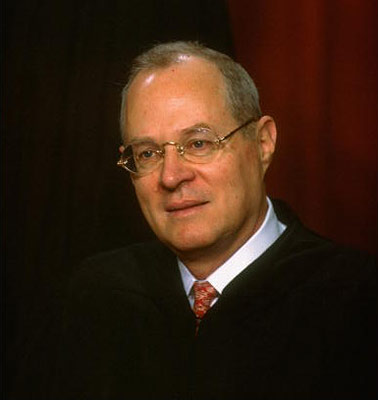
The Most Powerful Man in America

Ladies and Gentlemen, ken0-009may I present to you…

The Most Powerful Man in America, Justice Anthony Kennedy!

Kennedy’s presence on the Supreme Court as the one reliable “swing vote” between the liberals and conservatives means that it is he, and he alone, that has often made the difference between hugely important cases. Don’t believe me? His vote was the deciding one on:

  • The Unconstitutionality of DOMA
  • The right of the Boy Scouts to discriminate
  • The right of prisoners in Gitmo to habeas corpus hearings
  • The right of police to take DNA samples
  • The right of corporations to spend unlimited money in political campaigns (Citizens United)

Editorial cartoon of the day

DOMA Arigato

The defeat of DOMA is an important step, but the battle for justice and equality is never-ending. Thanks to the Court, someone can now get married in a state that doesn’t discriminate, move elsewhere, and still be able to get federal benefits such as joint tax filing and so on.

I’m sure I’ll have more to say about it later, but for now, I’m celebrating. After all, I have to — according to many religious fanatics, my 30 year heterosexual marriage is in danger of collapse because of this.

Editorial cartoon of the day

Note: this was first posted last March, long before the decision became public. Like anyone was surprised by Scalia’s opinion.

Editorial cartoon of the day

The Voting Whites Act

I was thinking all day about what I’d say about this latest Supreme Court decision … but couldn’t say it any better than Justice Ginsburg’s dissent, which was so biting that it caused Justice Alito to roll his eyes (because, you know, women! What do they know about the law, am I right, guys?).

supremes

“Just as buildings in California have a greater need to be earthquake­ proofed, places where there is greater racial polarization in voting have a greater need for prophylactic measures to prevent purposeful race discrimination,” she wrote.

“Congress approached the 2006 reauthorization of the VRA with great care and seriousness. The same cannot be said of the Court’s opinion today. The Court makes no genuine attempt to engage with the massive legislative record that Congress assembled. Instead, it relies on increases in voter registration and turnout as if that were the whole story. Without even identifying a standard of review, the Court dismissively brushes off arguments based on ‘data from the record’ … One would expect more from an opinion striking at the heart of the Nation’s signal piece of civil-rights legislation.”

She then listed many many examples of how the law had been used just in recent history to prevent discrimination, thus proving that it is needed.

Basically, the majority did what conservatives call “judicial activism” which they claim to hate (except when they don’t). This was a law that had been held Constitutional previously, and (as Ginsburg points out) was a re-enactment of an already existing law. The majority ignored the many examples Congress gave when it passed the law, and instead imposed its will over the elected officials and decided we didn’t need the law. That’s not what the Court is supposed to do.

What the majority said, when you boil it down, was “We agree there is still discrimination, but we don’t care.”

So now the floodgates are open. If you think Republicans had been trying to keep people from voting in the past, you haven’t seen anything yet.

Editorial cartoon of the day

Negative Affirmative Action

The Supreme Court today sent an affirmative action case concerning college admissions to the lower court to have them use the proper legal standards, so there’s no real decision — but when I discuss these kinds of cases with people, I am often surprised at how misunderstood affirmative action is.

Affirmative action began as a way to fix discrimination where it needed to be fixed. Imagine a factory in an area that is 50% minority. If the jobs in the factory required no experience, you’d expect 50% of the employees to be minorities, wouldn’t you? Just based on statistics. Well, of course that wasn’t always the case, especially in the 60s and 70s when affirmative action began. You’d have these places with 10% minority workers.

So what would happen is that the factory would have to explain themselves. If, for instance, they could show that of the job applications they received, only 10% were from minorities then perhaps that could explain it. But that usually didn’t happen. And so the factory was made to have a policy of accepting minorities to get to where they should have been had there been no discrimination.

Note: this never required you to hire someone who was not qualified. Never. Yet people who scream about “reverse discrimination” always try to give anecdotal examples of where that happened.

Most of the recent cases involve colleges, where there is a different objective. Colleges want to have a diverse student body. They like to get students from all over the country and all over the world, with different religions and beliefs and backgrounds and races. They also look to get people with different experiences and people who were leaders in their community.

It’s how you get a real education. Real education comes from getting lots of different viewpoints and not being in a room where everyone thinks exactly the same. (As an aside, I taught a Constitutional Law class for a semester at Curry College in Massachusetts back in the ’90s — the entire class was full of rich, spoiled white kids and I couldn’t get a good debate going no matter what the issue. It was terrible.)

Lawsuits such as the one the Supreme Court had today come from white kids who got better SAT scores but yet didn’t get in while a minority student whose scores weren’t so good did.

Are SAT scores everything? Do they predict future success? No, and all educators know that. They are an indication, but that’s just one of many factors to consider when accepting students. (Some schools now don’t even consider SATs when accepting students.)

Yet people scream “reverse discrimination” and only look at race when a minority person gets in over a white person. (For all you know, the minority applicant was an Eagle Scout who was High School President, plays a musical instrument, knows three languages, but tests poorly.)

And now we get back to the main point again — qualifications. Even if the minority student is not as qualified as the white student, he or she is still qualified. They’ve met the minimum requirement to get in, and once in, they will have to take the same tests and do as well as every other student or they will fail.